Brda
August 1, 2026, Photo archive
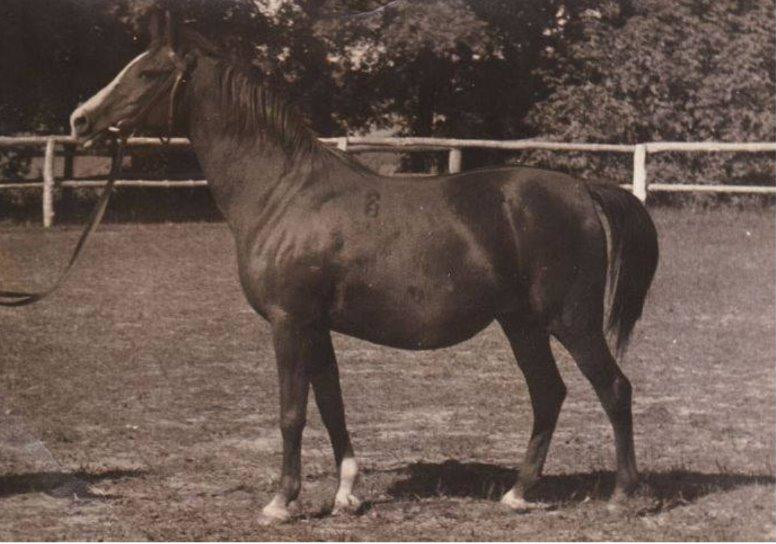
Brda
Registered as 215 Mersuch II-1, the chestnut mare Brda, whose name means "hills," was foaled in 1934 at the renowned Bábolna Stud in Hungary.
Brda's sire, Mersuch II, represented the Mersuch sire line developed at Bábolna Stud. He was a son of Mersuch I and traced in the direct male line to the desert-bred grey Hamdani Simri stallion Mersuch, foaled in 1898, bred by Hazaim Pasha, and imported to Bábolna in 1902 by General Fadlallah el Hedad. Mersuch became the foundation sire of a tail-male line that remained an important component of the stud's breeding program for generations.
In his history of the Bábolna Stud, Dr. Walter Hecker (1937-2017), former Secretary General of the Hungarian Arabian Horse Breeders' Association, described Mersuch II as a stallion of outstanding nobility, Arabian type, and excellent proportions. A contemporary evaluation by Dr. h. c. Gustav Rau (1880-1954) likewise praised his pedigree, strong bone, movement, and prepotency, concluding that Mersuch II was a first-class breeding stallion despite a few minor conformational shortcomings.
On the maternal side, Brda descended from 21 Siglavy Bagdady III. 21 Siglavy Bagdady III was sired by Siglavy Bagdady III, better known as Kadi, a stallion bred at the Inocenzdvor Stud in the former Yugoslavia before being acquired by Bábolna. Her dam was by Koheilan IV, another influential breeding stallion that later stood at the Weil State Stud in Germany. Although 21 Siglavy Bagdady III produced only one registered foal, that single daughter would ensure the family's lasting legacy.
The female line traced directly to the desert-bred gray foundation mare 216 Semrie, a Koheylah Umm Urkub foaled in 1896 and imported to Bábolna in 1902 by General Fadlallah el Hedad. As Semrie's great-granddaughter, Brda would carry this historic female line into post-war Poland, where her descendants established one of the breed's most successful branches.
Brda's influence as a broodmare was significant. Her first registered daughter, Comtesse, was born at Bábolna in 1941 by the renowned Koheilan I. After Brda's transfer to Poland in 1946, she produced three additional daughters by three of the country's leading stallions of the era: Angara (1947) by Wielki Szlem, Buzra (1948) by Witraz, and Darda (1950) by Amurath Sahib. Although Buzra left no registered offspring, Comtesse, Angara, and Darda each established influential branches of Brda's family.
Comtesse became a foundation mare at Achental Stud in Germany. There she produced four purebred Arabian foals. Three of her daughters—Kokah by Kalif and the full sisters Koheylah and Kowiszkah by Wisznu—later became foundation mares in their own right, firmly establishing Brda's female line in post-war German breeding. Comtesse also produced the Shagya Arabian mare Kanya, whose son Sunil, by Sultan, placed third in the stallion class at the 1978 WAHO Show in Hamburg.
The eldest of Brda's Polish daughters, Angara, produced three colts, of which Arax, by Amurath Sahib, proved by far the most influential. Through descendants such as Nabeg, and later Neman, Menes, Balaton and Kubinec, his influence spread throughout Europe and beyond. Arax also appears in the pedigrees of numerous outstanding horses, including Marsianin, Maklouf, Targuia El Maklouf, Zagrobla and Drug, making Angara one of the most influential daughters of Brda.
Brda's youngest daughter, Darda, became an outstanding broodmare in her own right. She produced twelve foals, among them Dornaba and her full brother Dardir, both by Naborr. Dornaba was named U.S. National Champion Mare in 1966 and later Canadian National Champion Mare, while Dardir earned the titles of Swedish National Champion Stallion and European Champion Stallion. Another son, Dar, by Comet, was exported to the United States, where he stood at Patterson Arabians. Darda also founded a prolific female branch through daughters such as Druchna and Dratwa, whose descendants continued to shape breeding programs in both Poland and North America.
Brda's contribution to Arabian horse breeding proved extraordinary. Through Comtesse, she helped establish an enduring female line in post-war Germany. Through Angara and Darda, she became the ancestress of influential breeding stallions, champion show horses, and broodmares whose descendants continue to shape Arabian horse breeding around the world.
Brda's sire, Mersuch II, represented the Mersuch sire line developed at Bábolna Stud. He was a son of Mersuch I and traced in the direct male line to the desert-bred grey Hamdani Simri stallion Mersuch, foaled in 1898, bred by Hazaim Pasha, and imported to Bábolna in 1902 by General Fadlallah el Hedad. Mersuch became the foundation sire of a tail-male line that remained an important component of the stud's breeding program for generations.
In his history of the Bábolna Stud, Dr. Walter Hecker (1937-2017), former Secretary General of the Hungarian Arabian Horse Breeders' Association, described Mersuch II as a stallion of outstanding nobility, Arabian type, and excellent proportions. A contemporary evaluation by Dr. h. c. Gustav Rau (1880-1954) likewise praised his pedigree, strong bone, movement, and prepotency, concluding that Mersuch II was a first-class breeding stallion despite a few minor conformational shortcomings.
On the maternal side, Brda descended from 21 Siglavy Bagdady III. 21 Siglavy Bagdady III was sired by Siglavy Bagdady III, better known as Kadi, a stallion bred at the Inocenzdvor Stud in the former Yugoslavia before being acquired by Bábolna. Her dam was by Koheilan IV, another influential breeding stallion that later stood at the Weil State Stud in Germany. Although 21 Siglavy Bagdady III produced only one registered foal, that single daughter would ensure the family's lasting legacy.
The female line traced directly to the desert-bred gray foundation mare 216 Semrie, a Koheylah Umm Urkub foaled in 1896 and imported to Bábolna in 1902 by General Fadlallah el Hedad. As Semrie's great-granddaughter, Brda would carry this historic female line into post-war Poland, where her descendants established one of the breed's most successful branches.
Brda's influence as a broodmare was significant. Her first registered daughter, Comtesse, was born at Bábolna in 1941 by the renowned Koheilan I. After Brda's transfer to Poland in 1946, she produced three additional daughters by three of the country's leading stallions of the era: Angara (1947) by Wielki Szlem, Buzra (1948) by Witraz, and Darda (1950) by Amurath Sahib. Although Buzra left no registered offspring, Comtesse, Angara, and Darda each established influential branches of Brda's family.
Comtesse became a foundation mare at Achental Stud in Germany. There she produced four purebred Arabian foals. Three of her daughters—Kokah by Kalif and the full sisters Koheylah and Kowiszkah by Wisznu—later became foundation mares in their own right, firmly establishing Brda's female line in post-war German breeding. Comtesse also produced the Shagya Arabian mare Kanya, whose son Sunil, by Sultan, placed third in the stallion class at the 1978 WAHO Show in Hamburg.
The eldest of Brda's Polish daughters, Angara, produced three colts, of which Arax, by Amurath Sahib, proved by far the most influential. Through descendants such as Nabeg, and later Neman, Menes, Balaton and Kubinec, his influence spread throughout Europe and beyond. Arax also appears in the pedigrees of numerous outstanding horses, including Marsianin, Maklouf, Targuia El Maklouf, Zagrobla and Drug, making Angara one of the most influential daughters of Brda.
Brda's youngest daughter, Darda, became an outstanding broodmare in her own right. She produced twelve foals, among them Dornaba and her full brother Dardir, both by Naborr. Dornaba was named U.S. National Champion Mare in 1966 and later Canadian National Champion Mare, while Dardir earned the titles of Swedish National Champion Stallion and European Champion Stallion. Another son, Dar, by Comet, was exported to the United States, where he stood at Patterson Arabians. Darda also founded a prolific female branch through daughters such as Druchna and Dratwa, whose descendants continued to shape breeding programs in both Poland and North America.
Brda's contribution to Arabian horse breeding proved extraordinary. Through Comtesse, she helped establish an enduring female line in post-war Germany. Through Angara and Darda, she became the ancestress of influential breeding stallions, champion show horses, and broodmares whose descendants continue to shape Arabian horse breeding around the world.