Iwonka III
April 1, 2026, Photo archive
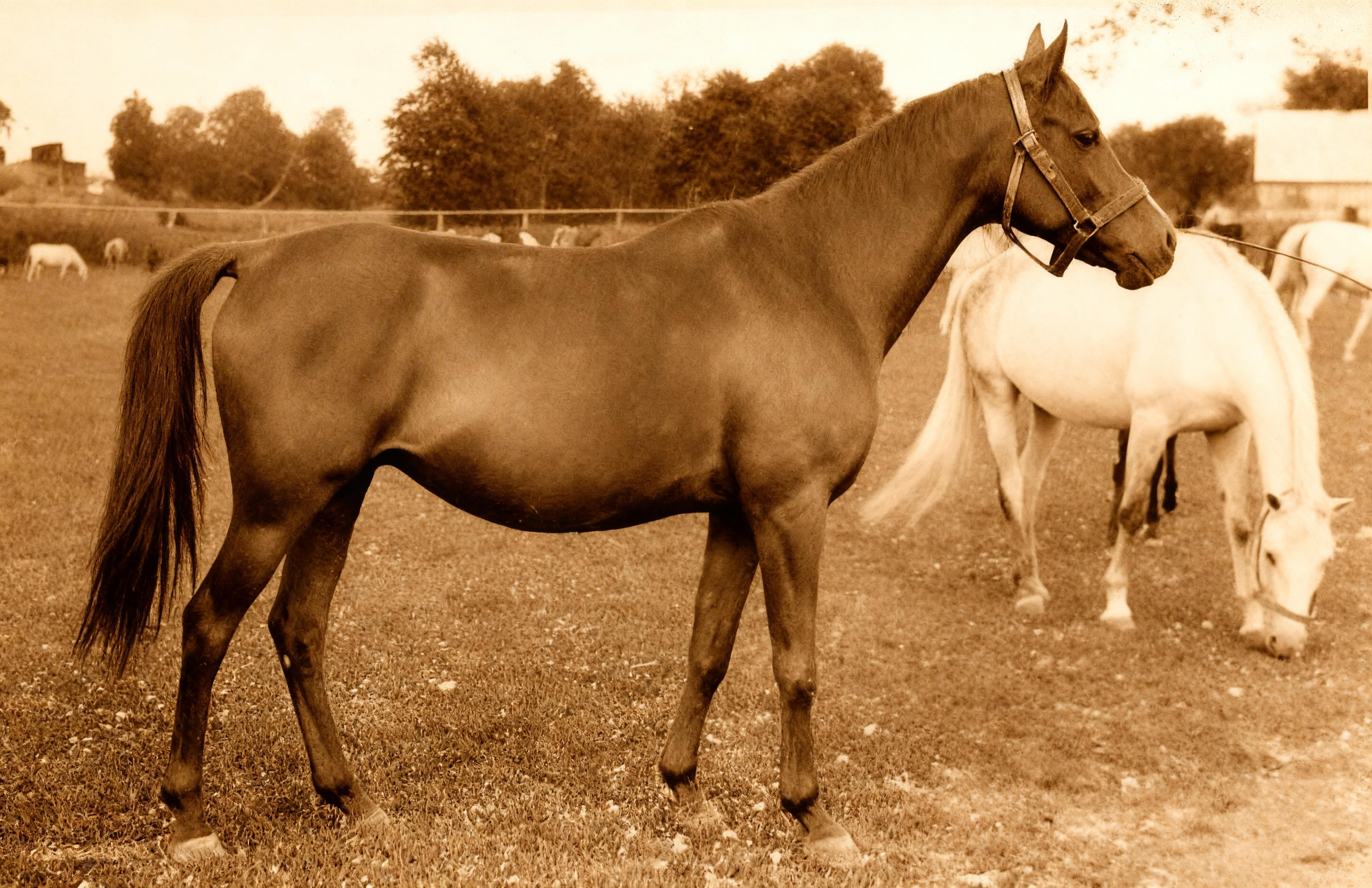
Iwonka III
The chestnut mare Iwonka III (1936–1960) was bred in Poland by Anny Bakowska at Krasnica Stud. Though modest in size at 14.2 hands, she became an important link between pre-war Polish breeding, wartime displacement, and the international development of Arabian bloodlines in the mid-20th century.
Her dam, Lysa (1915), was a chestnut mare by Hassizi out of Dzami I (by Dardzal). She proved to be a productive broodmare. Between 1927 and 1930, while at Bronice, she produced the mares Mabrucha (1928) and Safta (1929). Through Safta, this female line later yielded high-class racehorses, including the Derby and Oaks winner Sabellina, demonstrating the long-term significance of the family descending from the foundation mare Mlecha (c. 1840).
In 1935, Lysa was among the mares bred at Krasnica to Ibn Mahomet, resulting in the birth of Iwonka III in 1936. Ibn Mahomet (1925) was a chestnut stallion bred by Gumninska and owned by the Association of Improved Horse Breeders in Opoczno. At the time, he was the only purebred Arabian stallion standing within a county breeders’ association. His pedigree included numerous horses of desert origin and ultimately traced to the stallion Antar (1884), imported to the Sanguszko stud at Slawuta. Antar was later acquired by Homer Davenport for his Desert Arabian Stud, illustrating the early transatlantic circulation of Arabian bloodstock.
Ibn Mahomet also covered another mare at Krasnica, Lyska, producing Irenka in the same year. Contemporary accounts distinguish clearly between these mares, noting the success of Lysa’s produce in contrast to the less favorable results obtained from Lyska.
Before the Second World War, Iwonka III was transferred from Krasnica to Janów Podlaski, already in foal to Amurath Sahib. On 17 March 1941, she produced at Janow the filly Balalajka, a grey mare who would become central to her legacy. During the wartime upheavals, Iwonka III was among the horses displaced from Poland and was subsequently exported to the United States around 1945. She passed through the U.S. Government Remount Center in Pomona, California, and later came into the ownership of George E. Birkenshaw in Moorpark, California.
Iwonka III’s conformation, as evidenced by surviving photographs, reflects the classical Polish Arabian type of the pre-war period: a balanced and moderately refined mare with a well-set neck, strong body, and correct limbs, suited to functional use rather than extreme type. Such characteristics were typical of breeding programs that emphasized endurance, soundness, and versatility.
In the United States, Iwonka III continued to be used as a broodmare and produced a number of foals, including the stallion Iwonkatez (1959, by Witez II). Although Iwonkatez sired some good foals, it was through her daughters that Iwonka III achieved lasting significance.
Foremost among them was Balalajka (1941, by Amurath Sahib). Bred in Poland, she later produced, from the stallion Witraz, two horses of exceptional importance: the mare Bandola and the stallion Bask. Bandola became one of the most celebrated mares of Polish breeding and, through her son Bandos, contributed significantly to the development of post-war Polish Arabian lines. Bask, exported to the United States in 1963, became one of the most influential sires in modern Arabian breeding, with a profound impact on performance horse populations. Numerous prominent descendants, including Bey Shah, Huckleberry Bey, and Barbary, trace back to this line.
Another daughter, Isonda (1943, by Trypolis), was exported to Germany, where she became part of the foundation broodmare band at Achental Stud under Gertraude Griesbach. In this role, she contributed to the re-establishment of Arabian breeding in post-war Germany, representing a continuation of Polish bloodlines within a new national context.
Iwonka III is therefore best understood as a broodmare of historical importance whose influence was transmitted through multiple branches. Through Balalajka, her lineage achieved global prominence while through Isonda it contributed to the rebuilding of European breeding programs. In this way, her legacy spans continents and generations, illustrating the lasting impact of Polish Arabian breeding in the modern era.
Her dam, Lysa (1915), was a chestnut mare by Hassizi out of Dzami I (by Dardzal). She proved to be a productive broodmare. Between 1927 and 1930, while at Bronice, she produced the mares Mabrucha (1928) and Safta (1929). Through Safta, this female line later yielded high-class racehorses, including the Derby and Oaks winner Sabellina, demonstrating the long-term significance of the family descending from the foundation mare Mlecha (c. 1840).
In 1935, Lysa was among the mares bred at Krasnica to Ibn Mahomet, resulting in the birth of Iwonka III in 1936. Ibn Mahomet (1925) was a chestnut stallion bred by Gumninska and owned by the Association of Improved Horse Breeders in Opoczno. At the time, he was the only purebred Arabian stallion standing within a county breeders’ association. His pedigree included numerous horses of desert origin and ultimately traced to the stallion Antar (1884), imported to the Sanguszko stud at Slawuta. Antar was later acquired by Homer Davenport for his Desert Arabian Stud, illustrating the early transatlantic circulation of Arabian bloodstock.
Ibn Mahomet also covered another mare at Krasnica, Lyska, producing Irenka in the same year. Contemporary accounts distinguish clearly between these mares, noting the success of Lysa’s produce in contrast to the less favorable results obtained from Lyska.
Before the Second World War, Iwonka III was transferred from Krasnica to Janów Podlaski, already in foal to Amurath Sahib. On 17 March 1941, she produced at Janow the filly Balalajka, a grey mare who would become central to her legacy. During the wartime upheavals, Iwonka III was among the horses displaced from Poland and was subsequently exported to the United States around 1945. She passed through the U.S. Government Remount Center in Pomona, California, and later came into the ownership of George E. Birkenshaw in Moorpark, California.
Iwonka III’s conformation, as evidenced by surviving photographs, reflects the classical Polish Arabian type of the pre-war period: a balanced and moderately refined mare with a well-set neck, strong body, and correct limbs, suited to functional use rather than extreme type. Such characteristics were typical of breeding programs that emphasized endurance, soundness, and versatility.
In the United States, Iwonka III continued to be used as a broodmare and produced a number of foals, including the stallion Iwonkatez (1959, by Witez II). Although Iwonkatez sired some good foals, it was through her daughters that Iwonka III achieved lasting significance.
Foremost among them was Balalajka (1941, by Amurath Sahib). Bred in Poland, she later produced, from the stallion Witraz, two horses of exceptional importance: the mare Bandola and the stallion Bask. Bandola became one of the most celebrated mares of Polish breeding and, through her son Bandos, contributed significantly to the development of post-war Polish Arabian lines. Bask, exported to the United States in 1963, became one of the most influential sires in modern Arabian breeding, with a profound impact on performance horse populations. Numerous prominent descendants, including Bey Shah, Huckleberry Bey, and Barbary, trace back to this line.
Another daughter, Isonda (1943, by Trypolis), was exported to Germany, where she became part of the foundation broodmare band at Achental Stud under Gertraude Griesbach. In this role, she contributed to the re-establishment of Arabian breeding in post-war Germany, representing a continuation of Polish bloodlines within a new national context.
Iwonka III is therefore best understood as a broodmare of historical importance whose influence was transmitted through multiple branches. Through Balalajka, her lineage achieved global prominence while through Isonda it contributed to the rebuilding of European breeding programs. In this way, her legacy spans continents and generations, illustrating the lasting impact of Polish Arabian breeding in the modern era.