Salon
January 12, 2026, Photo © Balaskhin Collection
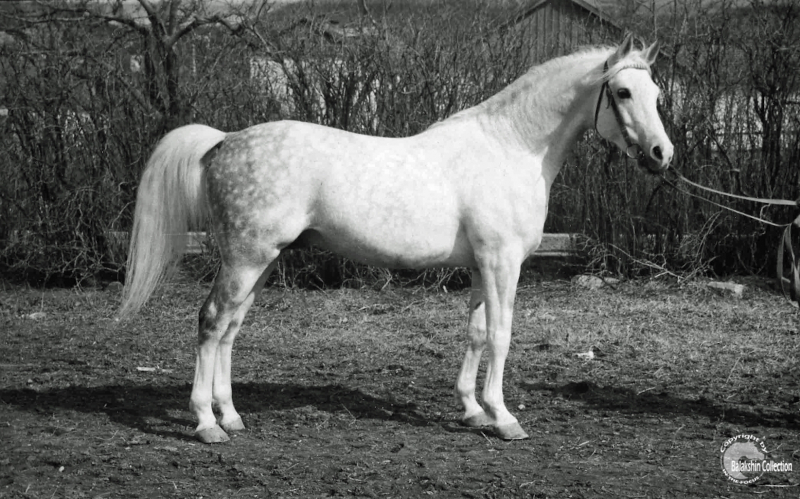
Salon
Born on April 27, 1959 at the legendary Tersk Stud, Salon stands among the most influential stallions of the Straight Russian breeding program in the 1960s and 1970s.
This grey stallion was sired by Negatiw, one of the most important stallions to stand at Tersk in the post-war period. Negatiw himself was bred at Tersk and combined international refinement with unmistakable strength. He was by Naseem, often considered the best son of Skowronek. Bred in Poland, Skowronek was one of Lady Wentworth’s most influential sires at Crabbet Park. Negatiw was out of Taraszcza, a mare by Enwer Bey who was deported during World War II and taken to Tersk.
Salon’s dam, Sonata was a daughter by Skrzyp and out of Odaliska (by Ofir). Her chestnut sire Skrzyp was bred at Janow Podlaski in 1936 and stood at stud in Russia until he was sold to Malkabardinsky Stud in 1954 where he was used for the Kabardian horses breeding program.
Odaliska was bred at Tersk and served in the stud's broodmare band until her death some when after 1956.
Through her heritage, Sonata represented the hazy yet potent Polish–Russian blend that emerged when war displaced both horses and bloodlines across borders. Sonata proved herself not only as Salon’s dam but also as a highly influential broodmare, producing Suvenir (by Negatiw) and Sopka (by Priboj), thereby cementing her importance within the Tersk broodmare band.
Raised at Tersk among an exceptional cohort of colts, Salon distinguished himself early despite the intense internal competition that characterized the stud. He was sent to the racetrack, where his performance, while not spectacular, was solid and respectable: one win, five seconds, and three thirds from nineteen starts during his two- and three-year-old seasons.
Retired from racing in 1962, Salon underwent the rigorous stallion evaluation process employed by Tersk officials. Passing these stringent standards, he was awarded the coveted designation of “Elite.” This classification would soon be justified in the breeding shed.
Initially bred to a limited number of mares, Salon quickly demonstrated his prepotency. As confidence in him grew, so did both the quantity and quality of mares assigned to him. Year after year, he transmitted substance and correctness.
Salon rose to the position of chief sire at Tersk where he sired 64 registered offspring, comprising 36 fillies and 28 colts—a remarkable number during that time.
Among his most notable Russian-bred sons and daughters were Muscat, Muslin, Podsnejnik, Moment (who would himself become chief sire at Tersk), Namet (Namiet) and Pesenka. Through his maternal grand-daughter Panagia, Salon can be found in the pedigree of Princip (by Nabeg), European Champion Stallion Balaton (by Menes) and European Champion Mare Poshlina (by Naslednik). He can also be found in pedigrees of performance horses such as Gomel (by Peleng x Miest by Salon), an international dressage competitor, multiple champion, and European and National show champion.
Many of Salon's descendants later found their way into international breeding programs, particularly in the United States, where they helped establish Salon’s reputation abroad.
Salon’s excellence was also recognized in the show ring. In 1969, at ten years of age, he was presented at the Moscow All-Union Exhibition, where he was awarded a Certificate of First Degree. Significantly, two of his four-year-old daughters shown at the same exhibition received the same distinction, underscoring his ability to reproduce quality across generations and sexes. In subsequent years, additional Salon daughters earned Certificates and Championships at All-Union level.
In 1971, Salon was exported to West Germany. Despite these credentials, Salon was used sparingly in Germany. Over the course of nearly a decade, he sired only 24 purebred offspring. This limited utilization is often attributed to the prevailing focus of German breeding programs at the time, which were heavily concentrated on Straight Egyptian bloodlines. As a result, Salon—despite his proven record—remained largely underestimated in Western Europe.
Salon’s true international renaissance began in 1980, when American breeder Robert D. Stratmore of California sought him out after encountering several of his Russian-bred sons and daughters. By then, Salon was 21 years old, and concerns about transporting an aging stallion across the Atlantic were justified. Nevertheless, he arrived in the United States in excellent condition and took up residence at Make-Believe Farms, already renowned for its Russian-bred Arabians.
Demand for Salon was immediate and extraordinary. His initial stud fee of $15,000, later rising to $35,000, reflected both his proven status and the confidence breeders placed in his genetic legacy. Over the next three years, Salon sired 118–119 offspring in the United States.
By mid-1983, Salon’s health began to decline, and he was officially retired from breeding. He died in 1984, at the age of 25.
This grey stallion was sired by Negatiw, one of the most important stallions to stand at Tersk in the post-war period. Negatiw himself was bred at Tersk and combined international refinement with unmistakable strength. He was by Naseem, often considered the best son of Skowronek. Bred in Poland, Skowronek was one of Lady Wentworth’s most influential sires at Crabbet Park. Negatiw was out of Taraszcza, a mare by Enwer Bey who was deported during World War II and taken to Tersk.
Salon’s dam, Sonata was a daughter by Skrzyp and out of Odaliska (by Ofir). Her chestnut sire Skrzyp was bred at Janow Podlaski in 1936 and stood at stud in Russia until he was sold to Malkabardinsky Stud in 1954 where he was used for the Kabardian horses breeding program.
Odaliska was bred at Tersk and served in the stud's broodmare band until her death some when after 1956.
Through her heritage, Sonata represented the hazy yet potent Polish–Russian blend that emerged when war displaced both horses and bloodlines across borders. Sonata proved herself not only as Salon’s dam but also as a highly influential broodmare, producing Suvenir (by Negatiw) and Sopka (by Priboj), thereby cementing her importance within the Tersk broodmare band.
Raised at Tersk among an exceptional cohort of colts, Salon distinguished himself early despite the intense internal competition that characterized the stud. He was sent to the racetrack, where his performance, while not spectacular, was solid and respectable: one win, five seconds, and three thirds from nineteen starts during his two- and three-year-old seasons.
Retired from racing in 1962, Salon underwent the rigorous stallion evaluation process employed by Tersk officials. Passing these stringent standards, he was awarded the coveted designation of “Elite.” This classification would soon be justified in the breeding shed.
Initially bred to a limited number of mares, Salon quickly demonstrated his prepotency. As confidence in him grew, so did both the quantity and quality of mares assigned to him. Year after year, he transmitted substance and correctness.
Salon rose to the position of chief sire at Tersk where he sired 64 registered offspring, comprising 36 fillies and 28 colts—a remarkable number during that time.
Among his most notable Russian-bred sons and daughters were Muscat, Muslin, Podsnejnik, Moment (who would himself become chief sire at Tersk), Namet (Namiet) and Pesenka. Through his maternal grand-daughter Panagia, Salon can be found in the pedigree of Princip (by Nabeg), European Champion Stallion Balaton (by Menes) and European Champion Mare Poshlina (by Naslednik). He can also be found in pedigrees of performance horses such as Gomel (by Peleng x Miest by Salon), an international dressage competitor, multiple champion, and European and National show champion.
Many of Salon's descendants later found their way into international breeding programs, particularly in the United States, where they helped establish Salon’s reputation abroad.
Salon’s excellence was also recognized in the show ring. In 1969, at ten years of age, he was presented at the Moscow All-Union Exhibition, where he was awarded a Certificate of First Degree. Significantly, two of his four-year-old daughters shown at the same exhibition received the same distinction, underscoring his ability to reproduce quality across generations and sexes. In subsequent years, additional Salon daughters earned Certificates and Championships at All-Union level.
In 1971, Salon was exported to West Germany. Despite these credentials, Salon was used sparingly in Germany. Over the course of nearly a decade, he sired only 24 purebred offspring. This limited utilization is often attributed to the prevailing focus of German breeding programs at the time, which were heavily concentrated on Straight Egyptian bloodlines. As a result, Salon—despite his proven record—remained largely underestimated in Western Europe.
Salon’s true international renaissance began in 1980, when American breeder Robert D. Stratmore of California sought him out after encountering several of his Russian-bred sons and daughters. By then, Salon was 21 years old, and concerns about transporting an aging stallion across the Atlantic were justified. Nevertheless, he arrived in the United States in excellent condition and took up residence at Make-Believe Farms, already renowned for its Russian-bred Arabians.
Demand for Salon was immediate and extraordinary. His initial stud fee of $15,000, later rising to $35,000, reflected both his proven status and the confidence breeders placed in his genetic legacy. Over the next three years, Salon sired 118–119 offspring in the United States.
By mid-1983, Salon’s health began to decline, and he was officially retired from breeding. He died in 1984, at the age of 25.